when people ask me if i’d want to live in ancient rome, i tell them no, and i usually explain it with something like “oh i couldn’t live without electricity,” or “life was not great for women back then,” or something similar, but the real reason i couldn’t live in ancient rome is because those fuckers didn’t have commas, and if i couldn’t include an extreme overabundance of commas in my writing, both for the sake of clarity and so that i could add a number of pointless asides, i think i’d pretty much die
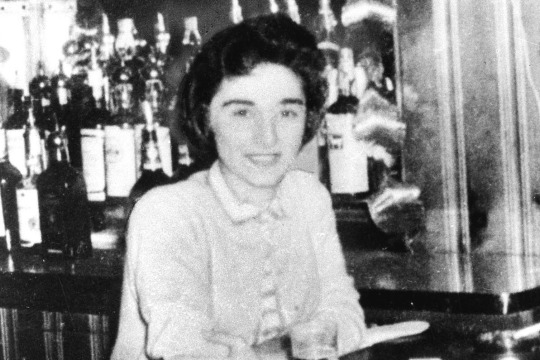
I was told by my professors that Kitty Genovese was a 28-year-old unmarried woman who was attacked, raped, and brutally murdered on her way home from her shift as manager of a bar. I was told that numerous people witnessed the attack and her cries for help but didn’t do anything because they “assumed someone else would”. Nobody intervened until it was too late.
Now… is it likely that people overheard Kitty’s cries for help and ignored them because they thought someone else would deal with it? Or, perhaps, did they ignore her because they knew she was a lesbian and just didn’t care?
Maybe that’s not the case. Maybe it was just a random attack. Maybe her neighbours didn’t know she was gay, or didn’t care.
But it’s a huge chunk of information to leave out about her in a supposedly scientific study of events, since her sexuality made her much more vulnerable to violent crimes than the average person. And it’s a dishonour to her memory.
RIP Kitty Genovese. Society may only remember you for how you died, but I will remember you for who who were.
this was one of the first lessons I had in psych too and we were never told about this either nor was it in any of the reading materials
I never knew this.
I also never knew this about Kitty Genovese, but I do know that, in fact, many of the dozen (not thirty-eight) people who witnessed some part of the attack (which took place after 3AM, on a chilly night in March when most people’s windows were closed) tried to help in some way.
One shouted out his window for the attacker to leave her alone, which did successfully scare the man off temporarily.
Another called the police but, seeing her still on her feet, said only that there had been a fight but the woman seemed to be okay.
And when Kitty Genovese was finally attacked in a vestibule where she couldn’t be seen from outside, Karl Ross, a neighbor, saw what was happening but was too frightened himself to go to her rescue–so he started calling other neighbors to ask what he should do. Eventually one of them told him to call the police, which he did, and the woman he called, Sophie Farrar, rushed out to help Kitty even though she didn’t know whether the attacker was gone.
Kitty Genovese died in the arms of a neighbor who tired to help and comfort her while they waited for the police and ambulance to arrive. Kitty was in fact still alive, although mortally wounded, when the ambulance reached the scene.
The man who saw the final stabbing? Who panicked and called other neighbors first instead of the police? The man who said, infamously, that he “didn’t want to get involved” because he was reluctant to turn to the police for help? He was thought to be gay himself. He was a friend of Kitty and Mary Ann’s. After being interviewed by the police he took a bottle of vodka to Mary Ann and sat with her, trying to comfort her.
So, no. I don’t think the evidence indicates that Kitty Genovese’s neighbors let her die because she was a lesbian, because Kitty Genovese’s neighbors tried to help.
(Also, going by the content of the murderer’s confession, it was indeed a random attack.)
how on EARTH was this “scientifically” studied but the details gotten so wrong and the wrong as hell conclusion published and taught in schools?!?!?! where were those scientists observation skills?! on vacation?!
How to take facts and turn them into an urban legend that gets taught in schools: Make a bad made-for-t.v.-movie about it, watch it, believe everything the movie says, annnnnnnd go! That’s how it gets taught as this supposed “scientific study.” Someone got fucking lazy.
i dont know what it is about loose persimmons that makes me astral project into a past life as a street urchin in 12th century urban china but when i see that mom’s bought some I immediately give into the impulse to stuff at least 2 of them into my pockets with greedy lil hands
hey everyone whats your astral projection food/experience
uh whenever I eat bread and water I feel like an impoverished little child lost in the woods trying to ration her food to stay alive
holding a cup of hot soup makes me feel like a street urchin gratefully accepting some soup from the soup kitchens and clutching it in my freezing grimy fingers
and lastly whenever i eat a hot pastry i turn into another street urchin grabbing it from a bakery and hunkering down in the winter behind a cart to break it in half and eat it quickly
@tinawiththeglasses Hdjskdhfkdjs Savinien de Cyrano de Bergerac is an actual historical figure, a libertine, who wrote Les Etats et Empires de la Lune and du Soleil, inspired by Lucian’s True History – and basically the books are constantly saying “wtf is going on”. Rostand wrote his play inspired by the character ahaha !
Since Medusa was a priestess who was raped in Athena’s temple and was given the “monstruous” gift of turning people who looked at her into stone…
What if Poseidon actually raped her while “being” a statue that was inside the temple? I mean, we know Greek gods love to transform into…… various things to rape women so….
This would explain how he got into the temple in the first place, and would shed a… terrifying light on her “curse” while being a pretty accurate metaphor of sexual trauma imo. Like – we know that Athena cursing Medusa for desecrating her temple is a misogynistic reconstruction of the myth and that it was actually bound to protect Medusa from future assaults (with Medusa’s head being a symbol for women’s houses & shelters). But what if Medusa misunderstood the curse or… somehow made it herself?
She would turn every person (cough man cough) who stared at her into a statue, thus reliving her trauma each time which is… something that happens to rape survivors and would be ironic because it would both make them unable to harm her and similar to her rapist (so, a case of both externalisation and retraumatization)
Now i know greek statues actually had eyes and not just the… blank unnerving white thing we see them having, but still – a statue’s eyes are just… chiseled void. Which means she had seen the statue’s blank stare becoming an actual stare and, after that, could turn any living stare into a blank stone one. Is it a good or a bad thing? I guess it depends on how you understand it
I find it pretty symmetrical this way because, after all, the gods are creative and their “curses” are usually just the cursed person’s behavior reversed into a punishment or gratification. So that would explain the fact she turns living breathing people into statues